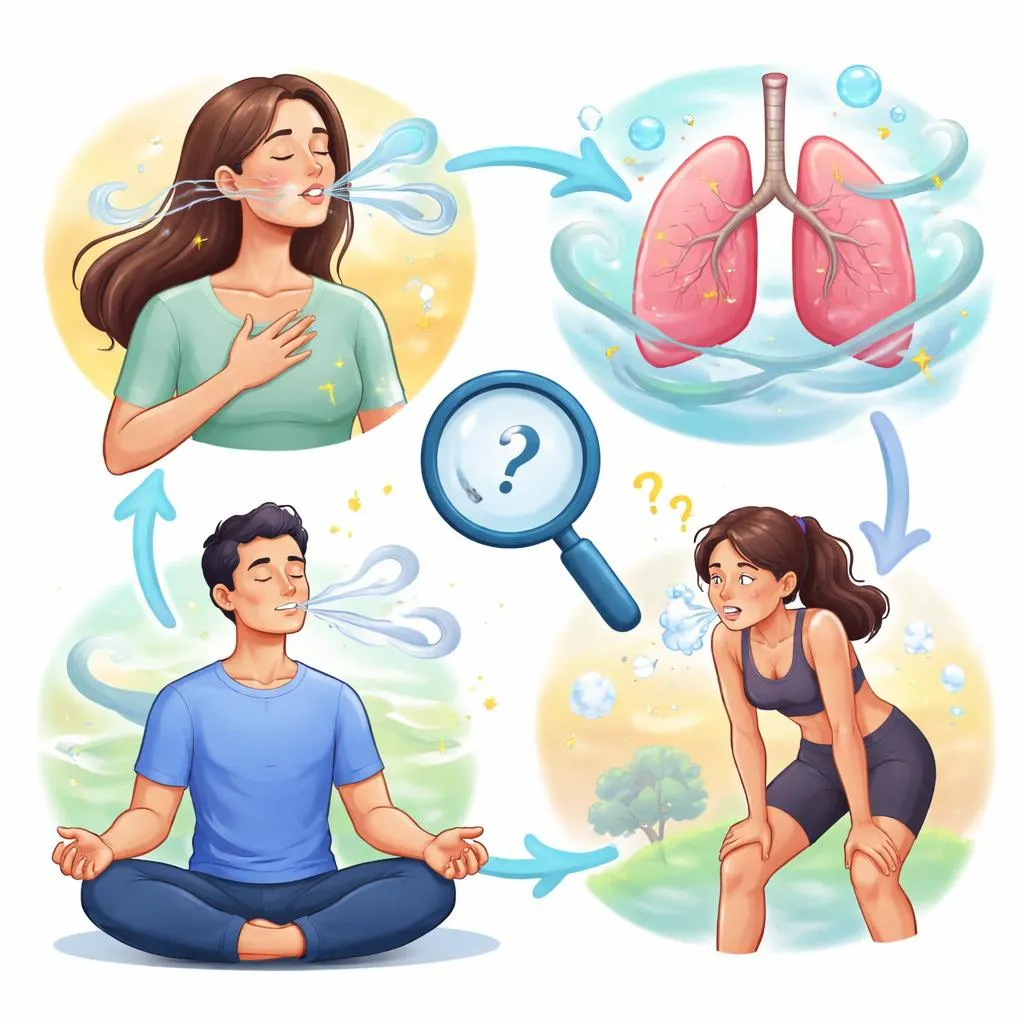

Air goes in. Air goes out. That is breathing.
Every living thing does it. But the words for this action can be tricky.
Today we learn four words. “Breathe,” “breath,” “breathing,” and “breathless.”
They look similar. They sound different. They have different jobs.
Parents and children can master these words together. Let us take a deep breath and begin.
What Does “Same Word, Different Forms” Mean?
One idea becomes several words. The idea is air moving in and out of your body.
“Breathe” is a verb. It means to do the action. “Please breathe slowly.”
“Breath” is a noun. It names the air itself. “Take a deep breath.”
“Breathing” is a noun or adjective. “Her breathing is quiet.” Or “a breathing exercise.”
“Breathless” is an adjective. It means without enough breath. “The run left me breathless.”
Same root. Different endings. Different jobs. The air stays the same.
Personal Pronouns Change Their Form
Pronouns change for grammar. “I” becomes “me.” “She” becomes “her.”
Our words change for action or thing. “I breathe deeply.” Action. “My breath is warm.” Thing.
“Your breathing sounds fast.” Activity. “We felt breathless after climbing.” Feeling.
Pronouns help us avoid repetition. Word families help us talk about bodies clearly.
When children learn the difference, they sound like native speakers.
From Verb to Noun to Adjective to Adverb – One Family, Many Words
“Breathe” is a verb. “Breathe in through your nose.” Action.
“Breath” is a noun. “His breath smelled like toothpaste.” Thing.
“Breathing” is a noun. “Deep breathing calms the body.” Activity.
“Breathing” can also be an adjective. “A breathing mask helps patients.”
“Breathless” is an adjective. “The view left me breathless.” Describes a person or feeling.
We have no common adverb. “Breathlessly” comes from “breathless.” That is an adverb. “She ran breathlessly.”
But for now, focus on the four main words.
One Root, Many Roles – How Words Grow from Actions to Qualities
The root comes from Old English “br?t.” It meant odor or vapor. Later it meant the air you exhale.
“Breathe” came from adding an “e” to the noun. That “e” changes the sound. It turns the noun into a verb.
This is a common pattern in English. “Bath” becomes “bathe.” “Wreath” becomes “wreathe.” “Sheath” becomes “sheathe.”
From “breath” we add “-less” to make “breathless.” Less means without. Without breath.
From “breathe” we add “-ing” to make “breathing.” The action continues.
Help your child see this pattern. A noun + e often becomes a verb.
Same Meaning, Different Jobs – Is It a Verb or a Noun?
Look at “breathe” and “breath.” This pair confuses many people.
“Breathe” has a verb job. “I cannot breathe in this crowded room.” Action.
“Breath” has a noun job. “Take a breath before you speak.” Thing.
The sound is different too. “Breathe” rhymes with “seethe.” The “e” at the end is long.
“Breath” rhymes with “death.” Short sound. No “e” sound at the end.
Now look at “breathing.” Always a noun or adjective. “His breathing was steady.” Noun. “A breathing tube.” Adjective.
“Breathless” is always an adjective. “We were breathless after laughing so hard.”
Teach children to listen to the sound first. Then look at the job.
Adjectives and Adverbs – When Do We Add -ly?
We add “-ly” to “breathless.” It becomes “breathlessly.” This is an adverb.
“She spoke breathlessly after her run.” Means she had trouble breathing while speaking.
We do not add “-ly” to “breathe” or “breath.” No “breathely.” No “breathly.”
We can add “-ly” to “breathing.” “Breathingly” is very rare. Skip it.
For children, focus on “breathless” and “breathlessly.” The second one is useful.
“He ran breathlessly to the finish line.” Good sentence. Clear meaning.
Watch Out for Tricky Spelling Changes (Double Letters, y to i, and More)
Spelling has two important things to watch. The silent “e” and the “th” sound.
“Breathe” has a silent “e” at the end. That “e” makes the vowel long. Breathe rhymes with seethe.
“Breath” has no “e.” Short vowel sound. Breath rhymes with death.
For adding endings: “Breathe” drops the “e” for “breathing.” Breathe becomes breath + ing.
“Breathe” drops the “e” for “breathed.” Breathe becomes breath + ed.
“Breath” adds “-less” to make “breathless.” No change. Just add.
“Breath” adds “-ing”? No. “Breathing” comes from “breathe,” not “breath.”
This is a common spelling trap. Write “breath” for the noun. Write “breathe” for the verb. The “e” changes everything.
Practice this with your child. Say the word. Ask “Does it have the long e sound at the end?” If yes, add the “e.”
Let’s Practice – Can You Choose the Right Form?
Try these sentences. Fill in the blank with breathe, breath, breathing, or breathless.
Please _____ deeply before you blow out the candles. (action verb)
Take a slow _____ and count to ten. (noun, the air)
The doctor checked the patient’s _____. (activity)
The long run left her completely _____. (adjective, out of air)
I cannot _____ through my nose when I have a cold. (action verb)
His _____ smelled like mint gum. (noun, the air from his mouth)
The _____ exercise helped me calm down. (adjective describing exercise)
She felt _____ with excitement when she saw the puppy. (adjective, overwhelmed)
Answers: 1 breathe, 2 breath, 3 breathing, 4 breathless, 5 breathe, 6 breath, 7 breathing, 8 breathless.
For number 8, “breathless” can mean very excited. So excited you forget to breathe.
Tips for Parents – Help Your Child Learn Word Families in a Fun Way
Put your hand on your chest. Say “I breathe.” Feel the action.
Say “Take a breath.” Feel the air. The noun is the air itself.
Practice the sounds together. “Breath” short. “Breathe” long.
Play a game. You say a sentence with a blank. Your child chooses breath or breathe.
“I need to _____.” (breathe) “Hold your _____.” (breath)
Blow up a balloon. “Take a deep breath. Now blow.”
Run in place for thirty seconds. Then say “I feel breathless.”
Read a book with a scary part. Say “This part leaves me breathless.”
Use “breathing” for calm moments. “Let us do breathing together.” Breathe in. Breathe out.
Do not shame mistakes. This pair confuses many adults too.
Celebrate when your child says “I need to breathe.” That means they remember the verb.
Draw a picture of lungs. Label “breathing” next to it.
Tomorrow you will see “breath” in a song. You will hear “breathe” in a movie.
Your child might say “This joke left me breathless with laughter.” You will cheer.
Keep practicing the sounds. Keep feeling your breath. Keep using the words. Your child will grow in language and in body awareness.